AI factories in Europe: who will own the tokens
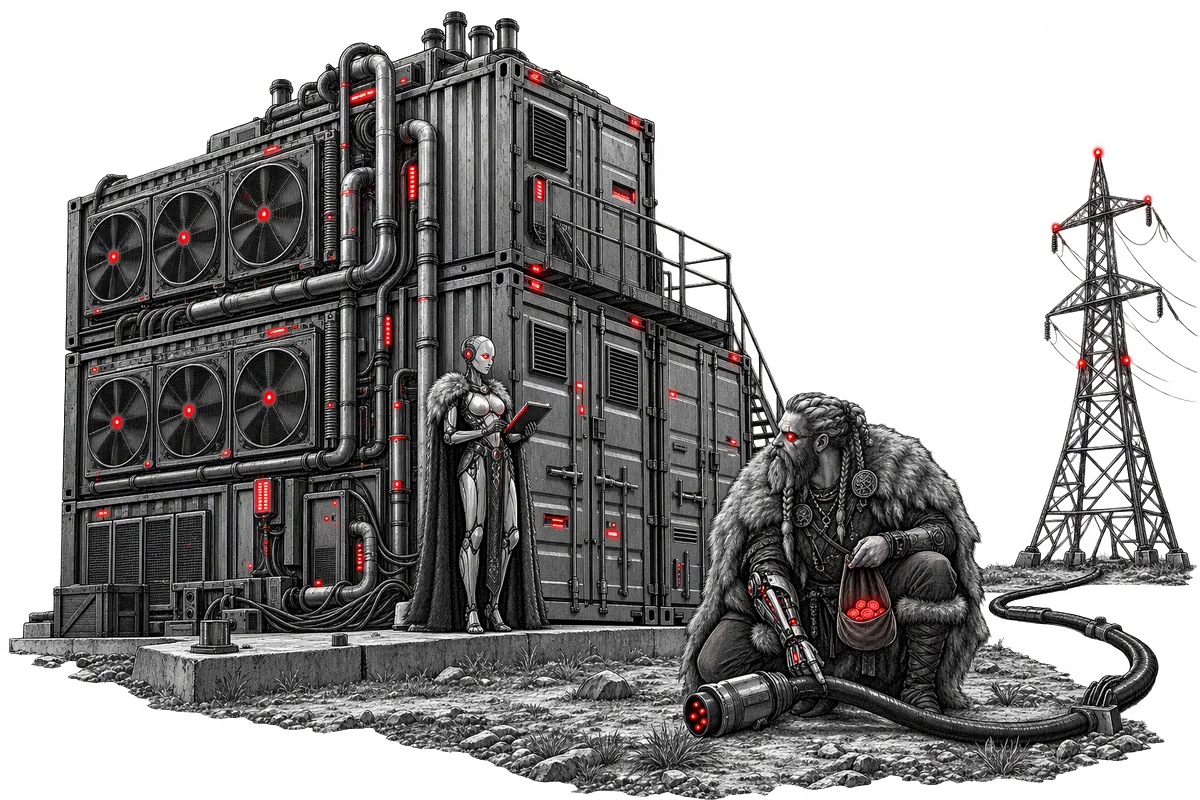
Picture the owner of a forty-person distribution company a year from now. Three agents work for her every day: one chases invoices, one answers supplier mail, one prepares the stock report. Each runs for hours, calls tools, rereads documents, tries again. At the end of the month a line on the card statement says how many million tokens that took and what they cost.
She did not buy software. She bought output from a factory she has never seen. The question worth asking is whose factory that is, where it stands, and what decides the price.
What was announced in Berlin
On 21 October 2026, at GTC in Berlin, NVIDIA introduced DSX POD: a reference design for complete AI factories on its Vera Rubin platform, built by partners in modular containers that are integrated and tested before delivery, with compute, networking, cabling, rack power and liquid cooling inside. On a site that already has power, water and a network connection, NVIDIA says installation drops from six months to as little as 14 days. Deliveries are planned from early 2027. Seventeen partners are named, among them Bull, Dell, HPE, Lenovo, Schneider Electric, Vertiv, Eaton, Foxconn and Crusoe.
Jensen Huang’s framing is that an AI factory creates value when it produces tokens, not when the construction ends. That is a useful sentence, because it is honest about the product. The factory sells tokens. Our owner buys them.
Europe is building its own side of this. We covered the policy layer in EU tech sovereignty: what Brussels is building. Poland already hosts two EuroHPC AI factories, PIAST in Poznań and Gaia in Kraków, and the EuroHPC call for AI gigafactories opened on 30 July 2026.
The real bottleneck is a cable, not a container
A container shortens the build. It does not bring electricity. Analysts at Futurum point out that in Europe the binding constraint is access to power from the grid, and DSX POD does not change that. The fourteen days start after someone has secured a connection, and that queue is measured in years, not weeks.
At the same time demand keeps climbing. A chat answer is a few hundred tokens. An agent that works for an afternoon, with several of them running side by side, is a different order of magnitude. So the question of who owns the tokens comes down to three older questions: who owns the grid connection, who owns the hardware behind it, and who sets the price at the counter.
Where an owner gets this wrong
Treating tokens like a utility. Electricity has regulated tariffs and several suppliers on the same wire. Tokens have a price list that the seller can change, models that are retired on the seller’s schedule, and no obligation to keep either stable.
Reading “European” as “ours”. A factory in Europe may run on American chips, be built by a Taiwanese contract manufacturer, be operated by a cloud from anywhere and sell access through a reseller. Location matters for law and latency. It does not tell you who can switch you off.
Ignoring where the power comes from. Capacity will go first where the grid connection already exists. If your provider’s growth depends on a connection that has not been granted, your price and your availability depend on it too.
Writing every workflow against one API. Prompts, tools and tests built for one vendor’s model and endpoint turn a price rise into a migration project. That is the rental agreement again, with a meter attached.
Not counting at all. Most companies cannot say which task used how many tokens last month. Without that, there is no way to tell whether a price change matters, or whether a task should run somewhere else.
What to do instead
- Measure tokens per task. Not per seat and not per month: per job. The invoice agent, the supplier mail, the report. That is your bill of materials.
- Keep the model swappable. Write workflows so that the model is a setting, not a foundation. Open weights make this real, because the same model can run at more than one provider, or at home.
- Own what sits around the model. Your data, your prompts, your tool definitions and your evals are the parts no factory can take with it.
- Ask your provider three questions. Where does the inference run? Who owns the hardware? What happens to my price and my model when the contract renews?
- Keep one task at home. A small local model for one routine job is a fallback and a price check at the same time.
- Watch the public option. Check whether, and on what terms, the EuroHPC AI factories offer access to a firm like yours before you assume they are not for you.
None of this needs a factory of your own. It needs you to treat tokens as a supply you buy, not a magic that arrives.
A test for this week
Open last month’s AI invoices. Next to each one write the task it paid for, the model it used and the provider that ran it. Then mark every line where you could not move that task to another model or another provider within a week.
Every marked line is a place where somebody else owns your tokens. More on what this podcast is about is on the home page.
Sources: NVIDIA, DSX POD announcement, 21 October 2026, NVIDIA, DSX POD product page, Futurum Group.
- AI factories
- tokens
- inference
- energy
- EU